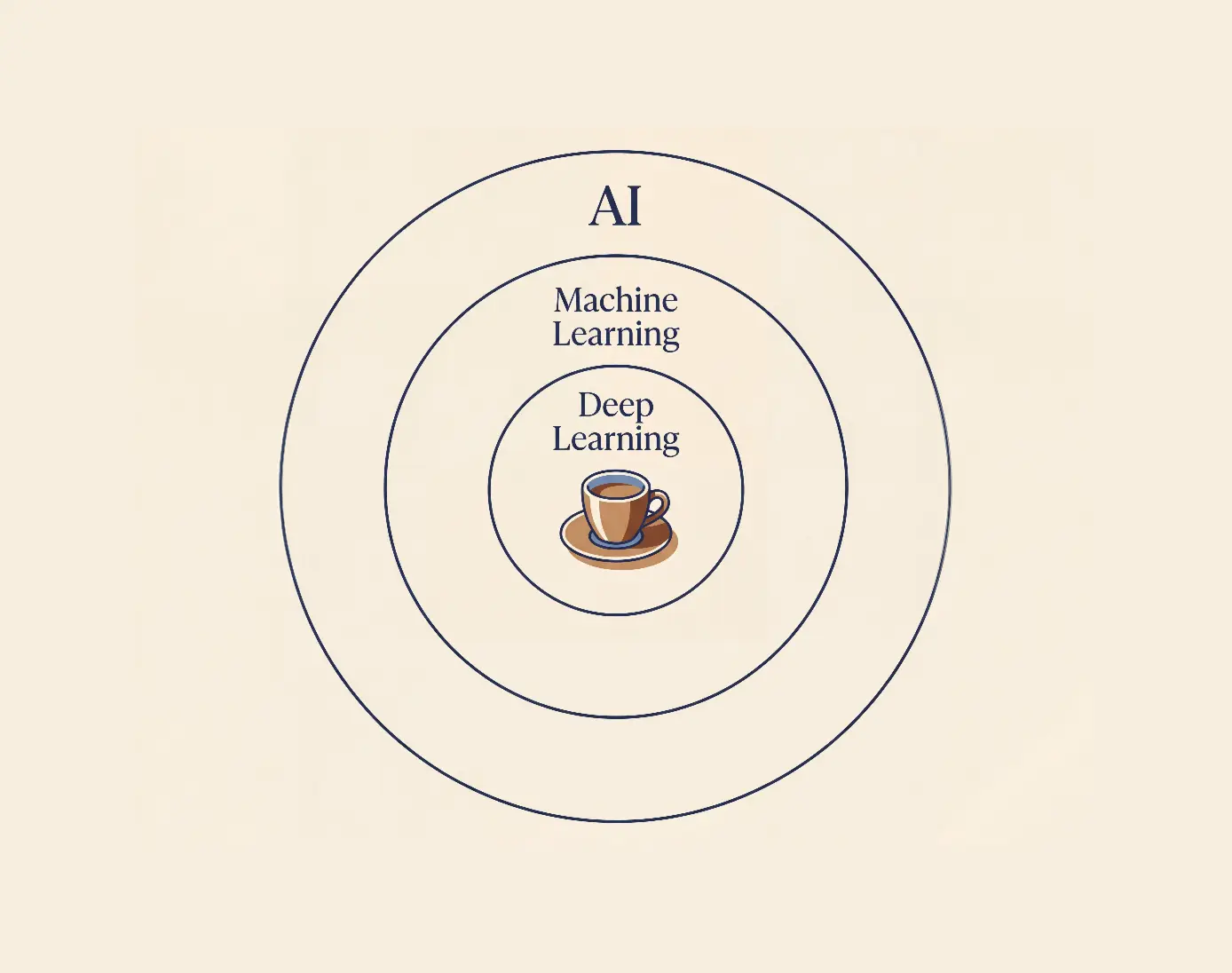
AI Decoded #2 of 8
Youre Mixing Up Electricity and Coffee Machines — Heres the Hierarchy
AI, ML, Deep Learning, Neural Networks — everyone uses them interchangeably. Theyre not the same. Heres the hierarchy that makes the rest of AI finally make sense.
Sundar Rajan
Feb 18, 2026
6 min read
Part 2 of 8 — AI Decoded for Founders | Layer 1: The Foundation
A vendor walks into your firm for a demo.
In the first sixty seconds, they say: "Our platform is powered by deep learning and natural language processing, built on transformer architecture, to deliver AI-driven market intelligence."
Four technical terms. One sentence. You write them all down. You still don't know if they're related, sequential, or four different ways of saying the same thing.
They're not the same. They're a hierarchy.
Once you see the hierarchy, the whole sentence makes sense. That's what this part covers.
What Lives in This Layer
Layer 1 is the foundation. It holds the terms that explain why modern AI is even possible — what it is, how it learns, and what makes it capable of understanding language, meaning, and images.
None of these are things you build or buy. They are decades of scientific research that gave computers the ability to think in ways that simply weren't possible before.
You don't need to know how they work. You need to know what they are — so that vendor claims have context, and conversations have a structure you can follow.
Here's the hierarchy before we go term by term:
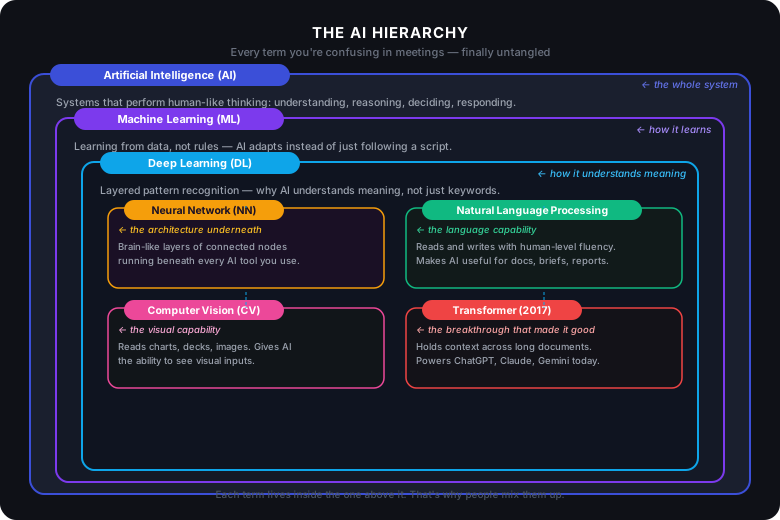
Each term lives inside the one above it. That's exactly why people mix them up. Now let's pull them apart, one at a time.
Artificial Intelligence (AI)
The umbrella over everything.
Any computer system that performs tasks which normally require human-like thinking — understanding, reasoning, deciding, responding.
When you use an AI tool to research a market, draft a client brief, or synthesise a competitor landscape, that's AI in action. It reads your question, thinks about what you need, and responds. That whole experience — perceiving, reasoning, producing output — is what "AI" means.
Think of it as the complete system. Not one feature, not one capability — the whole thing working together. Every other term in this layer lives inside it.
Machine Learning (ML)
How AI learns — without being manually programmed.
Instead of engineers writing rules ("if the question mentions risk, respond with this framework"), the system is trained on massive amounts of data. It reads millions of documents, figures out the patterns, and learns on its own.
Your AI research tool didn't get a rulebook about markets and strategy. It learned by reading thousands of research reports, analyst documents, and industry analyses. It figured out what good analysis looks like. Nobody programmed those patterns in. The system observed them and learned. That is machine learning.
Think of it like how a strong analyst develops their instincts — not by memorising a policy manual, but by working through hundreds of real client situations over time. Machine learning is that same process, running at enormous speed, across far more data than any person could ever read.
Deep Learning (DL)
The engine inside machine learning that gave AI real understanding.
Older AI matched keywords. Deep learning goes further — it grasps meaning.
When you ask your AI tool about "headwinds facing the sector," it understands you mean challenges — even though you never used that word. When a brief says "is this a good market to enter," it understands strategic intent, not just the words on the page. That shift — from matching words to understanding what you actually mean — is deep learning.
Think of the difference between a junior analyst and a senior one. The junior matches the words in a brief to their notes. The senior understands what the client is really worried about, even when they don't say it directly. Deep learning gave AI the senior analyst's kind of understanding.
Neural Network (NN)
The structure that makes deep learning work.
A system of connected mathematical nodes arranged in layers — modelled loosely on how the brain processes information. Your question goes in one end. Billions of weighted calculations happen invisibly across those layers. An answer comes out the other end.
You don't build neural networks for your firm. You don't configure them. But they run underneath every AI tool you use — and knowing they exist means you understand why AI can handle complex, nuanced inputs that simpler systems simply can't.
Think of it like the wiring inside a building's walls. You don't see it. You don't manage it. But without it, nothing turns on.
Natural Language Processing (NLP)
The language capability specifically.
This is what allows AI to read what you write — and write back in a way that sounds human. Not keyword matching. Actual comprehension of sentences, tone, intent, and structure.
When you type a brief to your AI tool and it responds with a structured, coherent analysis — that's NLP working on both ends. It read your input as language. It responded as language. For a firm that works in words — documents, client reports, strategic recommendations — this is the capability that makes AI genuinely useful.
Think of it as the language centre of the system. The part dedicated entirely to reading and writing with human-level fluency. Without it, you get a search engine. With it, you get something that can actually hold a real work conversation.
Computer Vision (CV)
The visual capability — AI that sees.
Not just text. When a client sends a competitor's slide deck, a market share chart, or a product brochure, AI with computer vision can look at those images and understand what they show.
For strategy and consulting work, this matters more than most firms realise. Analysis increasingly starts with visual inputs — presentations, graphs, screenshots, diagrams. Computer vision is what gives AI the ability to work with those materials alongside the text documents.
Think of it as giving your AI assistant a pair of eyes. Before computer vision, it could only work with documents you typed out. Now it can look at the same materials your team looks at — and pull insights from them.
Transformer
The architecture breakthrough that made modern AI actually good.
Introduced in a 2017 research paper titled "Attention Is All You Need."
Before transformers, AI processed text sequentially — and forgot what it read at the start of a long document by the time it reached the end. Transformers solved that. They gave AI the ability to hold context across an entire document — to understand how an idea introduced on page 3 relates to a conclusion on page 47, and to reason across long, complex inputs without losing the thread.
For a consulting firm, this is the specific breakthrough that makes AI useful. Client briefs are long. Research documents are long. Strategic analyses are long. A system that can't hold context across a dense document isn't useful for the work you actually do. Transformers are why it can.
Every major AI tool you use today — ChatGPT, Claude, Gemini — is built on transformer architecture. This is the reason they can handle nuanced, long-form, professional work.
The Foundation at a Glance
| Term | What it is | What it means for you |
|---|---|---|
| AI | Systems that perform human-like thinking | The umbrella; everything else lives inside it. |
| Machine Learning | Learning from data, not rules | Why AI adapts instead of just following a script. |
| Deep Learning | Layered pattern recognition | Why AI understands meaning, not just keywords. |
| Neural Network | The brain-like architecture | The structure running underneath; you don't build this yourself. |
| NLP | The language capability | Why AI can read and write with human-level fluency. |
| Computer Vision | The visual capability | Why AI can work with charts, decks, and images. |
| Transformer | The 2017 architecture breakthrough | The reason modern AI is as capable as it actually is. |
What this layer means for you as a strategic leader: None of these are things you choose, configure, or buy. They are the foundation underneath every AI product you will ever evaluate. Your first real decision — which AI systems to actually use — begins in the next layer. But knowing this one means that the next time a vendor says "powered by deep learning" or "built on transformer architecture," you're not just nodding at a label. You know what it means. And you know what to ask next.
What's Next
You now know what AI is built on. You know the hierarchy — and why mixing these terms makes every conversation harder than it needs to be.
Part 3 is where the real decisions begin.
There are specific AI systems your firm can access and build on today. They come in different types, with different strengths, different costs, and different tradeoffs. And choosing between them is less of a technical decision than most people expect.
It's more like a hiring decision. Part 3 shows you exactly how to make it.
We Build AI Employees to Work Alongside Your Team
Want to Have a Strategic Discussion?
Book A Discovery CallDon't miss out on an additional 5x to 10x revenue growth and stay ahead of competitors
The Meeting Where You Nodded Along Ends Here
The six-layer map that gives every AI term a place — and every founder a way back into the conversation theyve been faking.
Feb 18
•5 min read
Previous Article
This Isnt a Tech Decision — Its a Hiring Decision
LLMs, foundation models, open source, proprietary — these are the engines your strategy runs on. Heres how to choose the right one without a technical background.
Feb 18
•6 min read
Next Article