AI Decoded #1 of 8
The Meeting Where You Nodded Along Ends Here
The six-layer map that gives every AI term a place — and every founder a way back into the conversation theyve been faking.
Sundar Rajan
Feb 18, 2026
5 min read
Part 1 of 8 — AI Decoded for Founders
You're in a meeting with a CTO.
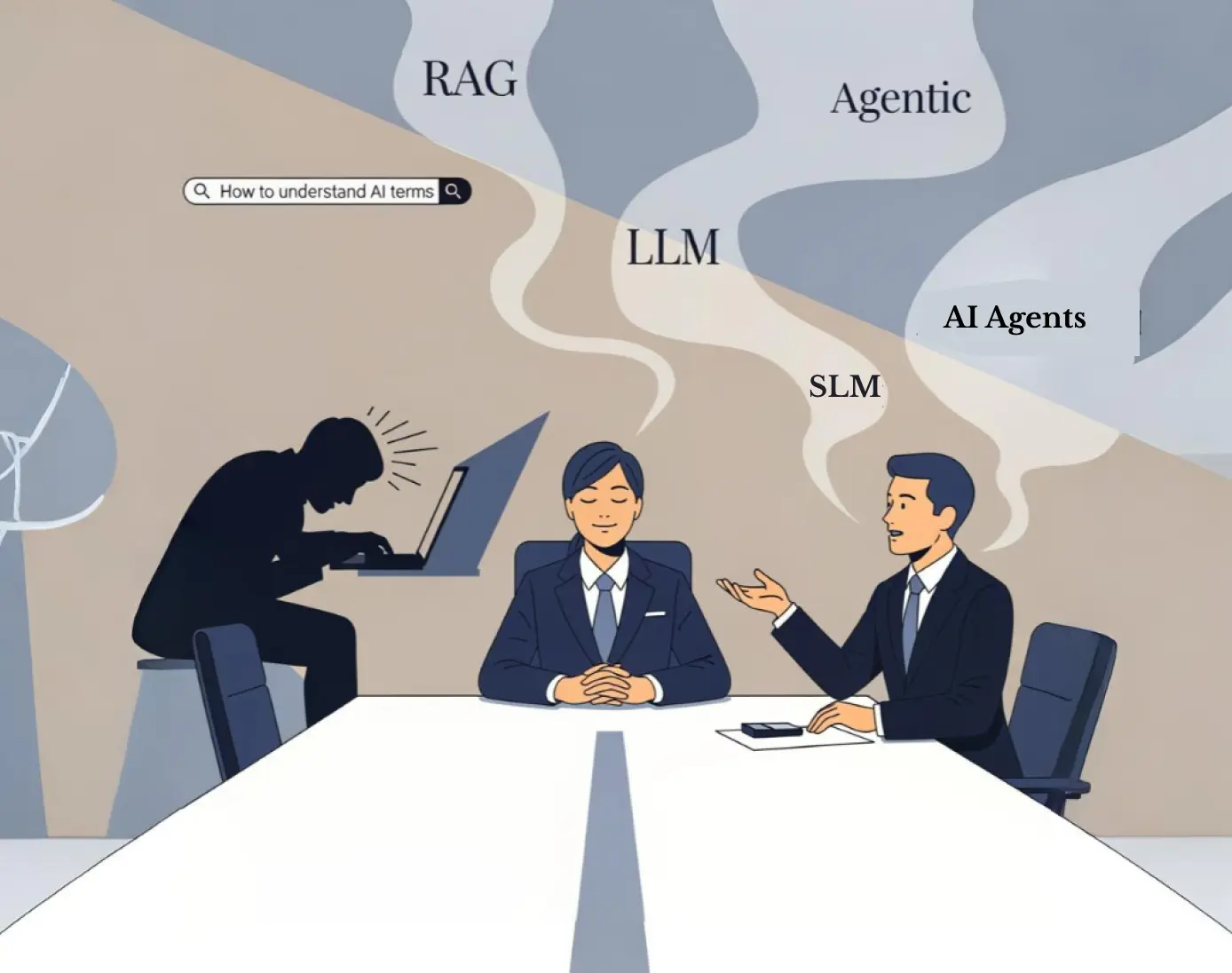
He's heard your firm is "doing AI." He leans forward and asks: "Are you using agentic workflows? Or more of a RAG-based approach for your research layer?"
You've heard both terms. Somewhere. You nod. You say your team is evaluating options. You move on.
That evening, you Google or ask ChatGPT.. both. Twenty minutes later, you're more confused than when you started. Because it assumes you already know which layer you're in.
You don't. Because nobody told you there are layers.
And here's the first thing I want you to know: that confusion is not your fault. It's a design flaw in how AI gets explained.
Almost every AI article is written for engineers — or for people who are already halfway there. Nobody sits down and explains the whole picture, clearly, in order, from the top.
That's exactly what this series does.
What You're Getting Into
This is not a technical course. You won't learn to build AI. That was never the point.
This is a mental map.
A way of organising every AI term you keep hearing so each one has a place, a purpose, and a clear relationship to everything else. Once you have this map, AI conversations stop feeling like noise. They start having structure — and you start having something to say in them.
Eight parts. This first part gives you the map. Parts two through seven walk through each layer in full — every major term, every business implication, every decision it points to. Part eight shows how all six layers connect and where your actual strategy begins.
But before the map, there's one insight that makes everything else click.
The Real Reason AI Conversations Feel Like Noise
Everyone — vendors, investors, your CTO, the articles you've read — mixes these AI terms together without explaining that they come from completely different levels.
Talking about machine learning and AI agents in the same breath is like talking about electricity and a coffee machine in the same sentence. Both are real. Both matter. But one is the infrastructure that makes the other possible. Mixing them up doesn't just make the conversation hard. It makes the decisions impossible.
These AI terms don't all live at the same level.
Some describe what AI IS — the science that made it possible. Some describe what you can USE — specific systems available today. Some describe how you make those systems work for YOUR firm. Some describe how AI lives inside your WORKFLOWS. Some describe how you keep it RUNNING. And some describe the decisions that only YOU — as the founder or CEO — can make.
Separate them into layers and every conversation has a structure. Every term has a home. Every confusing pitch becomes a set of questions you can actually answer.
Here are the six layers.
Layer 1: The Foundation
The science that made AI possible.
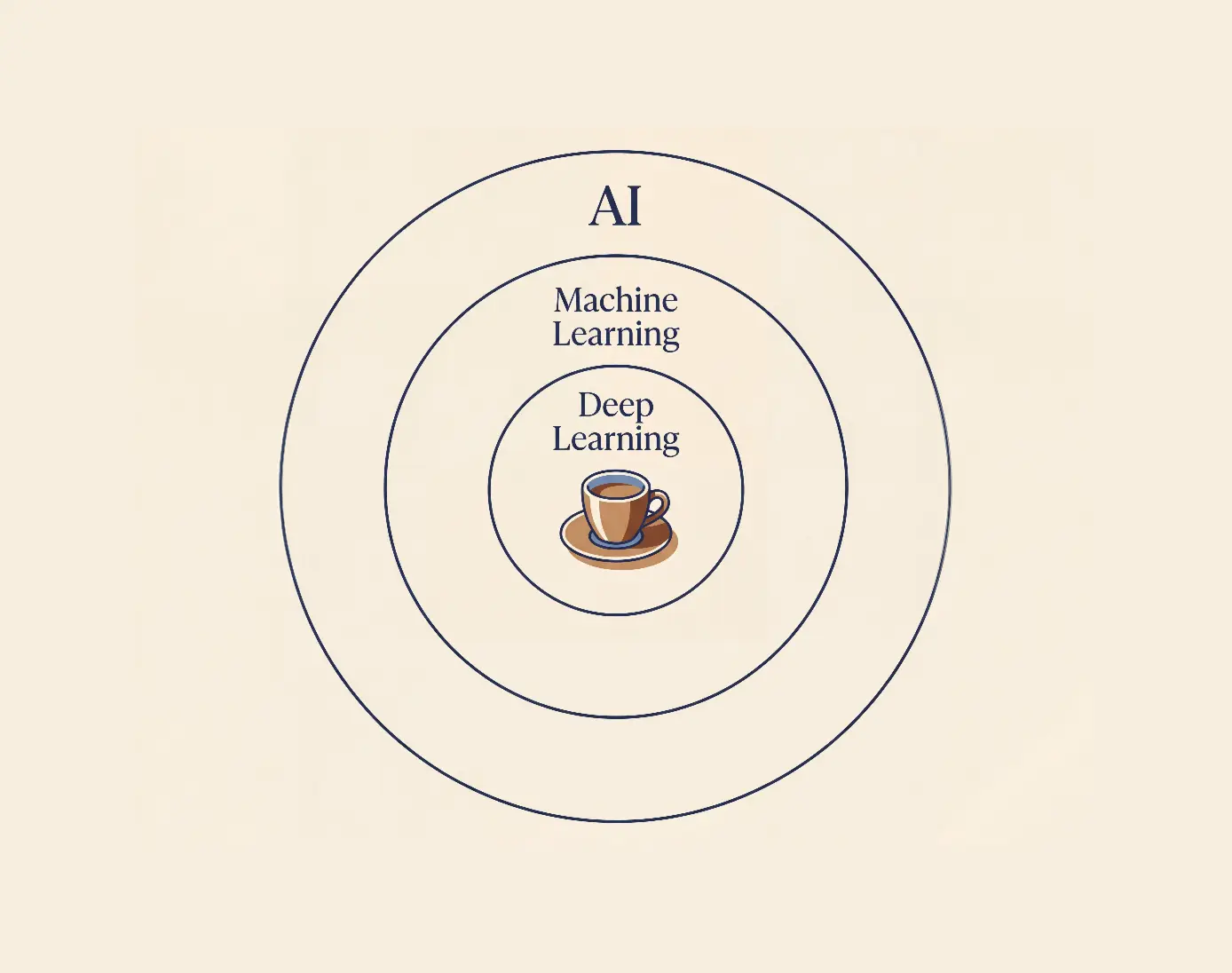
This layer has the terms that explain why modern AI exists at all — AI, machine learning, deep learning, neural networks, natural language processing, and the transformer architecture.
These are not things you build or buy. They are decades of research that gave computers the ability to learn from data, understand language, and see images. You don't need to know how they work. You need to know just enough to recognise when a vendor is using them meaningfully — and when they're just using them to sound impressive.
Part 2 walks you through every term in this layer. By the end, you'll know which of these actually matter for your decisions — and which ones are just noise in a pitch deck.
Layer 2: The Models
The AI systems you can actually use.
Think of this layer as the engine room. An LLM, a foundation model, an open-source model, a proprietary one — these are the specific AI systems your firm can access, rent, or build on. Each comes with different strengths, limits, and costs.
Choosing between them is one of your first real decisions. And it's less of a technical decision than most people think. It's actually a strategic one — because the model you choose shapes everything built on top of it.
Part 3 breaks down every model type in plain language and gives you a simple framework to choose — no engineering background required.
Layer 3: The Techniques
How you make AI useful for your firm specifically.
A model out of the box is brilliant — and completely clueless about your firm. It doesn't know your methodology, your clients, your standards, or your voice.
The techniques in this layer are how you close that gap. RAG gives the model access to your firm's knowledge before it responds. Fine-tuning shapes how it thinks and writes. Guardrails keep it from crossing professional lines. This is the layer where a generic AI becomes your firm's AI.
Part 4 explains each technique in plain English — and tells you which one you actually need first, and which ones most firms rush into too early.
Layer 4: The Application Patterns
How AI actually operates inside your business.
This is the most strategically important layer for most founders.
Does your AI work alongside your team as a copilot — suggesting, drafting, surfacing the right information while people stay in control? Or does it operate as an agent — taking a full task, completing it start to finish, and coming back with the result?
That one question, answered deliberately for each workflow in your firm, is your AI strategy. Everything else follows from it.
Part 5 gives you the full operating model — copilot vs. agent, multi-agent systems, orchestration — and how to decide what belongs where in your firm.
Layer 5: The Operations
How you keep AI working after it goes live.
Shipping an AI system is not the finish line. It's the starting line.
Inference tells you what it actually costs to run at scale. Latency tells you how fast it responds. Data drift tells you when it quietly starts getting worse. Evals tell you whether it's performing — before your clients tell you it isn't.
Most founders skip this layer. The ones who do, pay for it later — usually at the worst possible time.
Part 6 gives you the eight questions to ask before any AI system goes live. Ask them early and you'll be glad you did.
Layer 6: The Business & Leadership Language
The decisions that belong to you — not your technical team.
AI moat. AI governance. Frontier firm. Superworker. Strategic reservation.
These are not technical terms. They are leadership terms — the vocabulary of AI as a business discipline.
Your technical team can handle layers one through five. This layer is yours alone. It covers what you are building that competitors can't easily copy, who is accountable when an AI decision goes wrong, and what you've decided — clearly, out loud — will always stay human.
No model answers these questions. No roadmap resolves them on your behalf.
Part 7 walks through the nine questions that belong on your agenda as a founder — and only yours.
Your Map for This Series
| Part | Layer | Topic |
|---|---|---|
| Part 1 | - | The six-layer map |
| Part 2 | Layer 1 | The Foundation |
| Part 3 | Layer 2 | The Models |
| Part 4 | Layer 3 | The Techniques |
| Part 5 | Layer 4 | The Application Patterns |
| Part 6 | Layer 5 | The Operations |
| Part 7 | Layer 6 | The Business & Leadership Language |
| Part 8 | - | How It All Connects — and What to Build Next |
Read in order for the full picture. Or jump straight to the layer where a conversation is already happening in your firm. Either way, every part ends with a practical summary and the exact questions you should be asking as a strategic leader.
What Changes After You Read This
By the time you've worked through all eight parts, something specific shifts.
The next time a CTO asks whether you're using agentic workflows or a RAG-based approach — you won't nod and hope the topic moves on. You'll know exactly which layer that question belongs to. You'll know what it's really asking. And you'll know exactly what to say back.
That's not a small thing.
In a world where every firm is claiming to "do AI," the founders who actually understand it — not technically, but strategically — are the ones who build something that lasts. The ones who can't, keep nodding.
Let's make sure you're not one of them.
We Build AI Employees to Work Alongside Your Team
Want to Have a Strategic Discussion?
Book A Discovery CallDon't miss out on an additional 5x to 10x revenue growth and stay ahead of competitors