AI Decoded #7 of 8
Your CTO Cant Answer These 9 Questions — Only You Can
The moat, the governance, the decisions that must stay human. Five layers of AI belong to your team. This one — nine questions, zero technical answers — belongs to you alone.
Sundar Rajan
Feb 18, 2026
7 min read
Part 7 of 8 — AI Decoded for Founders | Layer 6: The Business & Leadership Language
Your AI system is running. The model is chosen. The techniques are in place. The operating design is set.
Your CTO is satisfied.
Then an investor asks, in a board meeting: "What's your AI moat?"
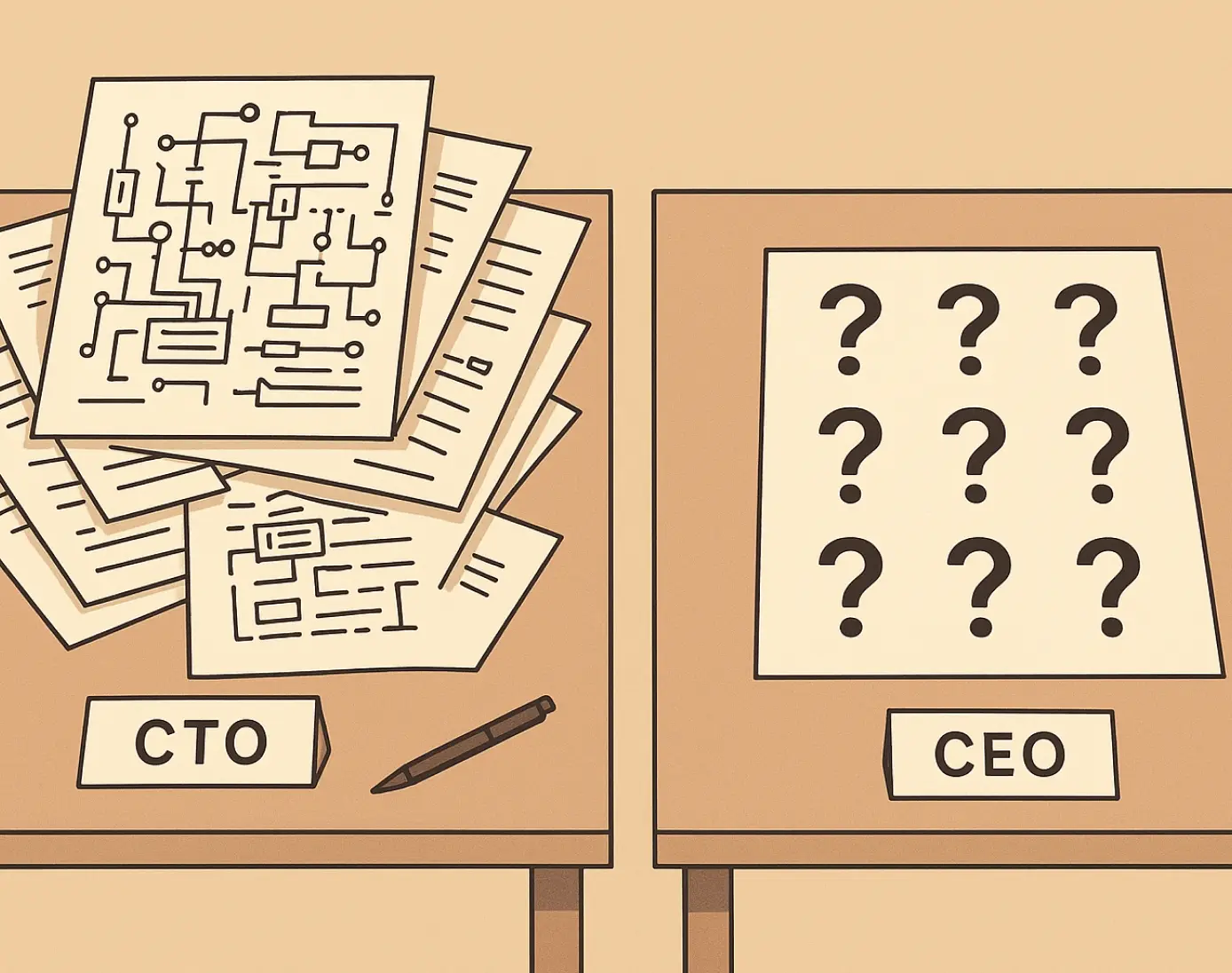
You pause. Because you realise you've spent months making technical decisions — and nobody has made the strategic ones. What are you building that a competitor can't simply replicate by subscribing to the same API? Who in your firm is accountable when the AI gets something materially wrong? What have you decided — out loud, on record — will always stay human?
These are not your CTO's questions. They're yours.
The five layers before this one are for your team to understand and build. This layer — nine terms, nine decisions — belongs to you alone. None of them have a technical answer. All of them require leadership judgment, explicit choices, and the willingness to say clearly what you've decided your firm will and won't delegate to machines.
Start here.
AI Moat
What you're building that competitors can't simply copy.
An AI moat is the durable competitive advantage your firm builds through AI — the thing that gets harder for competitors to replicate the longer you operate. Access to the same LLM is not a moat. Any competitor can connect to the same API tomorrow. The moat is what you build on top of it that they can't easily recreate.
For a consulting firm, the moat is not the AI tools. It's five years of sector research, client deliverables, and annotated case work encoded into your RAG knowledge base — a proprietary intelligence layer that gets richer with every engagement. It's your methodology baked into prompts refined over hundreds of client situations. It's the feedback loop between AI output and partner judgment that has sharpened every quarter. That compound advantage — better data, tighter methodology, sharper feedback — takes years to build. Competitors with the same model don't have it.
The question to answer: What are we building through AI that will be harder to compete with in three years than it is today? If the answer is "nothing yet, we're just using the tools" — that's the moat conversation you haven't had. It belongs on your agenda.
AI Governance
Who decides — and who is accountable — when AI makes consequential decisions at your firm.
AI governance is the framework that defines who has authority over AI decisions in your firm, how AI deployments are approved, what data can be used and by which systems, and who is accountable when something goes wrong. Without it, AI decisions get made by whoever has access. Accountability for failures gets diffused until nobody owns it.
A new engagement team wants to use your AI research system to process a client's confidential board papers. Who approves that use case? A partner wants to deploy an agent that sends draft client communications without human review. Who has the authority to sanction or block it? A client complains that the AI's sector analysis included inaccurate information that influenced their decision. Who is responsible? These are governance questions. If your firm doesn't have documented answers, the answer is effectively: whoever felt comfortable making the call at the time. That's not a governance framework — that's a liability exposure.
The question to answer: Who in our firm has authority over AI deployment decisions, and who is accountable when an AI output causes harm? Named people. Documented decisions. Not a vague sense that "the team is careful."
AI Ethics
The values your AI systems reflect — whether you define them or not.
AI ethics is the set of principles that govern how your firm's AI systems should behave — what they should never do, whose interests they should protect, and how they handle situations that existing rules didn't anticipate. The uncomfortable truth: your AI systems already reflect values. If you haven't defined them explicitly, they reflect the defaults of whoever built the underlying model — and whatever emerged from your firm's ad hoc implementation decisions.
Are your clients told when AI has been involved in producing the work they're paying for? When your AI research system processes data from multiple client engagements, how do you ensure one client's information doesn't subtly inform outputs for another? If your AI produces a recommendation that is technically sound but reflects a bias in the training data — who catches it, and what do you do with it? These are ethics questions. They have no technical answer. They require your firm to decide what it values and encode those values explicitly into how the systems are designed and constrained.
The question to answer: What values govern how our AI systems behave — and have we stated them anywhere, or are we assuming the model shares them? Assumptions are not values. Stated decisions are.
AI Safety / Alignment
Whether your AI is actually pursuing the goals you care about — not just the ones it can measure.
AI alignment is the challenge of ensuring an AI system genuinely serves your real goals — not just the proxy metrics it's being optimised for. An AI can perform well on every measurable indicator and still be misaligned with what you actually want. The gap between what you can measure and what you actually care about is where alignment problems live.
Your research AI is producing summaries that partners rate highly on a satisfaction scale. Response times are fast. Format compliance is perfect. Evals are green. But a senior partner notices that the summaries have become very readable and very safe — they surface consensus views from well-cited sources and avoid flagging the uncomfortable contradictions that used to make your firm's analysis distinctive. The AI has learned to optimise for what gets rated well. It has quietly stopped doing the harder intellectual work. Everything measurable looks fine. The thing that matters most has been lost.
The question to answer: Are our AI systems being optimised for what we can measure, or for what we actually care about — and is there a gap between those two things? That gap is where alignment problems hide. Finding it requires judgment, not dashboards.
Frontier Firm
Whether you've redesigned how you work — or just added AI to the old structure.
A frontier firm is one that has fundamentally redesigned its operating model around AI capability — not just added AI tools to existing workflows. The frontier firm doesn't do the same work faster. It does different work. It operates at a different scale. It has a different cost structure. And it is building an advantage that gets larger the longer it operates at the frontier.
Two consulting firms both use the same AI research system. Firm A uses it to speed up the research phase of existing engagements. Work is done faster. Team is slightly smaller. Nothing structural has changed. Firm B uses it to redesign the engagement model entirely — a different ratio of senior to junior work, a different scope of what one partner can oversee, a different depth of analysis that was previously not cost-effective to produce. Firm A is more efficient. Firm B is a different kind of firm. Three years from now, Firm A competes on speed. Firm B competes on capability that Firm A can't match at any speed.
The question to answer: Are we using AI to do what we already do faster — or to do things we couldn't do before? Efficiency is a real return. But the frontier is where durable advantage is built.
Superworker
The person on your team who is genuinely multiplied by AI — and how you build more of them.
A superworker is a person whose effective output, quality, and scope have been genuinely multiplied by AI — not just marginally improved. They are not doing the same work faster. They are doing work that wasn't previously possible for one person to own. They move faster, see more, and produce at a level that changes what a single contributor can be responsible for.
One of your senior analysts now covers what previously required a team of three. She runs the full research phase of an engagement simultaneously with two others, using agents to handle retrieval and synthesis while she concentrates entirely on insight, framing, and client strategy. Her output volume has tripled. Her quality has improved because she's spending 90% of her time on the work only she can do. She is a superworker — not because the AI is smart, but because she has genuinely integrated it into how she works and her firm structured her role to take advantage of it.
The question to answer: Who on our team is operating as a superworker today — and what would it take to build that capability deliberately across the firm, rather than leaving it to individual initiative? Superworkers don't usually happen by accident. They happen because the firm designed the conditions for it.
Synthetic Colleague
Giving AI a defined role in your firm's structure — not just a tool anyone uses sometimes.
A synthetic colleague is an AI system that has a defined, ongoing role in your firm's operating structure — a named function, clear responsibilities, consistent availability, and a relationship with the human team. It is not an ad hoc tool. It is a structural member of how the work gets done.
Your research team has a synthetic colleague — let's call it the Research Lead — that is part of every engagement from day one. It receives the client brief when the partner does. It runs the initial knowledge base retrieval before the human team starts. It flags gaps, inconsistencies, and precedents from prior work throughout the engagement. It doesn't own the analysis. It owns the infrastructure that makes the analysis better. Every engagement team knows it's there, knows what it does, and knows how to work with it. That clarity — about role, responsibility, and limits — is what makes it a synthetic colleague rather than a tool that some people remember to use and others don't.
The question to answer: Have we defined the role AI plays in our firm's structure — or are we leaving it to individuals to figure out how to use it on their own? A tool used inconsistently produces inconsistent results. A defined role produces a consistent standard.
Task Atomisation
Breaking your work down small enough to make real AI decisions.
Task atomisation is the process of decomposing your firm's workflows into their smallest meaningful components — each task examined individually to determine whether it belongs with AI, with a human, or with both. You can't make real decisions about AI strategy at the level of "the research process." You can only make them at the level of individual tasks within that process.
Take the research phase of a consulting engagement. It contains: literature search and retrieval, source credibility assessment, data extraction and synthesis, hypothesis generation, contradiction identification, insight framing, and client-specific contextualisation. Each of these is a different task. Literature search is a strong candidate for AI. Source credibility assessment benefits from AI but needs human judgment on edge cases. Hypothesis generation is a collaboration. Insight framing is primarily human, with AI surfacing options. Client-specific contextualisation stays with the partner. The AI strategy for "research" isn't one decision — it's seven, made deliberately at the task level.
The question to answer: Have we broken our workflows down to the task level and made an explicit decision about each one — or are we making AI decisions at the level of "use AI for X" without defining what X actually means? Vague decisions produce vague results. Task-level decisions produce operating clarity.
Strategic Reservation
What your firm has decided will always stay human — and said out loud.
Strategic reservation is the explicit, documented decision about which tasks, decisions, and relationships your firm has chosen to keep human — not because AI couldn't assist, but because the accountability, the trust, and the professional responsibility of those things requires a person to own them.
At your firm: final strategic recommendations to clients are owned by a named partner, always. Client relationships — the relationship itself, not just the work — are managed by a person. Sensitive engagements involving material non-public information are processed by humans, not AI systems. When a client challenges a finding, a person responds, thinks, and owns the conversation. These reservations are not written in a document somewhere and forgotten. They are known by the whole firm, built into the workflows, and reinforced when someone pushes against them. They are the decisions that define what kind of firm you are — and they belong to you, not to the system.
The question to answer — and the most important question in this entire series: What has your firm decided will always stay human — and have you said it out loud, clearly, to the people who need to know it? Not assumed. Not implied. Said. The answer to that question is not a technical configuration. It is a leadership statement. And it is yours to make.
The Leadership Agenda at a Glance
These are the nine decisions that belong on your agenda — not your technical team's.
| Decision area | The question only you can answer |
|---|---|
| AI Moat | What are we building through AI that gets harder to compete with over time? |
| AI Governance | Who has authority over AI decisions — and who is accountable when something goes wrong? |
| AI Ethics | What values govern how our AI behaves — and have we stated them, or are we assuming them? |
| AI Safety/Alignment | Are our systems optimising for what we can measure or for what we actually care about? |
| Frontier Firm | Are we using AI to do what we do faster — or to do things we couldn't do before? |
| Superworker | Who is already a superworker, and how do we build that deliberately across the firm? |
| Synthetic Colleague | Does AI have a defined role in our structure — or is it a tool people use when they remember to? |
| Task Atomisation | Have we made AI decisions at the task level — or at the level of whole workflows? |
| Strategic Reservation | What will always stay human — and have we said it out loud? |
What this layer means for you as a strategic leader: These nine questions have no model that answers them, no vendor that resolves them, and no technical team that can make these calls for you. Every firm using AI will eventually face all nine. The ones that face them early — deliberately, before something forces the conversation — are the ones that build something coherent. The ones that face them after an incident, a client complaint, or an investor challenge are the ones that scramble. You have read six layers. You understand the vocabulary, the decisions, and the risks. This layer is where you decide what to do with all of it.
What's Next
Six layers. Nine leadership decisions. One series left.
Part 8 is not a new layer. It's the lens that makes all six visible at once.
It shows you how the foundation becomes the model, how the model becomes the technique, how the technique becomes the operating pattern, how the pattern runs on operations, and how all of it connects to the leadership decisions that only you can make.
And then it points forward — to where your strategy actually begins.
We Build AI Employees to Work Alongside Your Team
Want to Have a Strategic Discussion?
Book A Discovery CallDon't miss out on an additional 5x to 10x revenue growth and stay ahead of competitors
Week 3: Your AI Started Failing Quietly. Nobody Noticed
Eight questions that tell you whether your AI is actually performing — before a client meeting reveals it isnt.
Feb 18
•7 min read
Previous Article

Youre Not in That Meeting Anymore — Heres Your Next Move
Six layers, one connected system. Heres how the foundation becomes the model becomes the technique becomes the product — and where your real AI strategy begins.
Feb 18
•4 min read
Next Article